
Object Record
Images
Metadata
Catalog Number |
1993.610 |
Object Name |
Recorder, Kinetophone |
Lexicon category |
6: T&E For Communication |
Description |
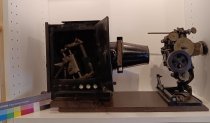
The Kinetoscope is a motion picture camera. The name "Kinetoscope" originates from the Greek word "kineto," meaning "movement," and "scopos," another word for "to watch." Edison wanted to improve upon the moving image technology of the 19th century. He filed a note with the patents office in 1888, expressing this intent. He wrote that he hoped to invent a device that would, "do for the eye what the phonograph did for the ear." It consisted of an upright wooden cabinet with a peephole with magnifying lenses in the top. Inside the box, the film was arranged around a series of spools. A large, electrically driven sprocket wheel at the top of the box engaged corresponding sprocket holes punched in the edges of the film, which was drawn under the lens at a continuous rate. Beneath the film was an electric lamp, and between the lamp and the film, a revolving shutter with a narrow slit. As each frame passed under the lens, the shutter permitted a flash of light so brief that the frame appeared to be frozen. This rapid series of apparently still frames appeared, due to the persistence of vision phenomenon, as a moving image. Edison's assistant, William Kennedy Laurie Dickson, was given the task of inventing the device in June 1889, possibly because of his background as a photographer. There has been some argument about how much Thomas Edison himself contributed to the invention of the motion picture camera. While Edison seems to have conceived the idea and initiated the experiments, Dickson apparently performed the bulk of the experimentation, leading most modern scholars to give Dickson most of the credit for turning the concept into a practical reality. |
Date |
ca. 1893 |
Dimensions |
H-49.5 W-13 D-24.625 inches |
Imagefile |
023\1993610.JPG |